
 01904 488599
Why Choose a Hotplate Stirrer with a Temperature Probe?
Understand the difference between plate and sample temperature, and when an external probe can help.
When a laboratory method specifies a temperature, it usually refers to the sample or solution being heated. Yet setting a hotplate to that temperature does not necessarily mean the liquid in your vessel has reached it.
A hotplate stirrer with temperature probe allows a compatible instrument to measure temperature directly within the sample and use that feedback to regulate heating. Combined with suitable stirring and careful setup, this helps you manage the conditions your method requires.
Here’s how an external probe works, when it is useful, and what to check before using one.
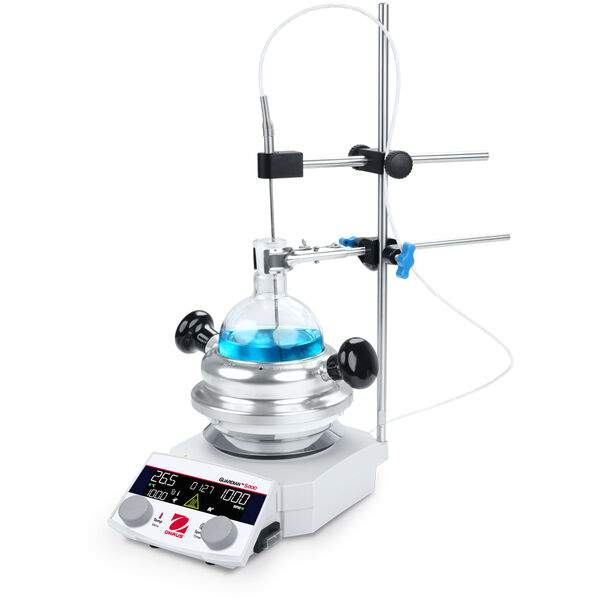
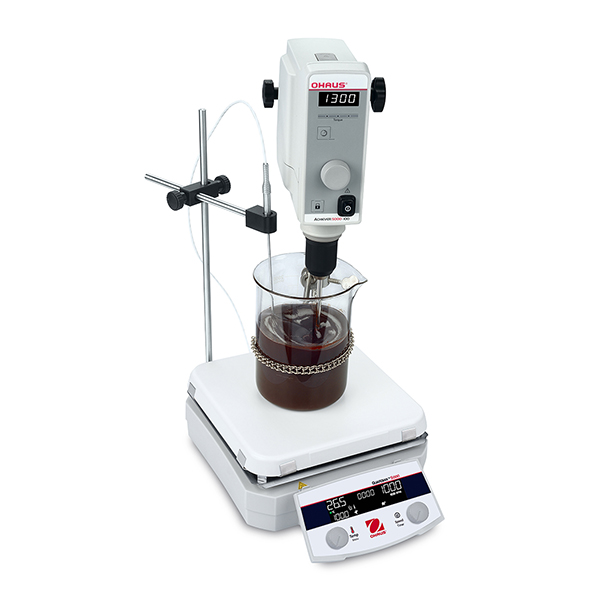
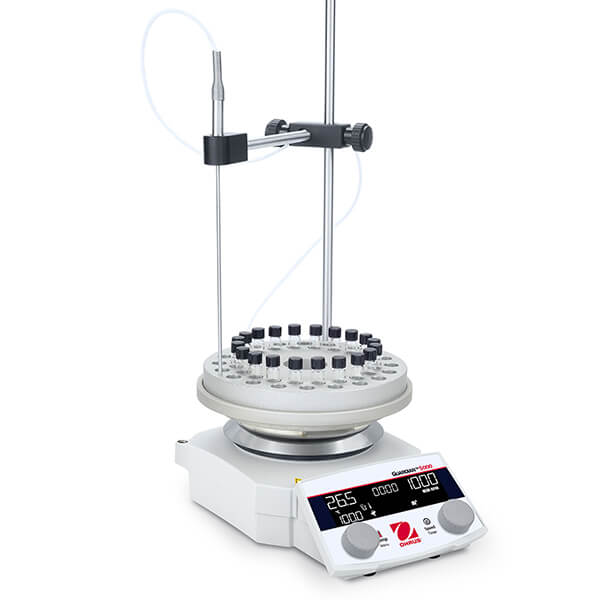
Plate temperature and sample temperature are different
Heat travels from the hotplate through the vessel and into its contents. The liquid takes time to warm up, and its temperature depends on factors including:
- The volume and properties of the sample.
- The vessel’s material, shape and contact with the plate.
- Heat loss to the surrounding environment.
- Whether the liquid is being stirred effectively.
For example, a plate set to 80°C does not establish that the solution is at 80°C. During heating, the plate and liquid can be at substantially different temperatures.
Understanding this distinction is central to hotplate stirrer temperature control. If your method depends on the liquid reaching a particular temperature, measuring the sample gives you more relevant information than relying on the plate setting alone.
How does an external temperature probe work?
An external temperature probe connects to a compatible instrument and sits within the liquid being heated. In sample control mode, the instrument uses the probe reading as feedback to adjust its heating output towards the selected sample temperature.
This differs from using a separate thermometer. A thermometer lets you check the temperature, while a compatible control probe also supplies feedback to the heater.
On the OHAUS Guardian 5000, connecting the external probe changes the displayed temperature from the heating plate temperature to the measured sample temperature.
The probe measures conditions at its sensing location. It does not establish that every part of the vessel is at exactly the same temperature, so positioning and mixing still matter.
When is sample temperature control useful?
A probe is particularly useful when temperature is a defined part of your method, rather than when you simply need to warm a liquid.
Preparing solutions and reagents
When preparation instructions specify a heating temperature, measuring within the solution helps you assess whether that condition has been reached. This can be useful when dissolving materials or preparing mixtures under controlled conditions.
Working with temperature-sensitive materials
Some samples need a controlled heating profile rather than rapid heating. Direct measurement helps you monitor the sample’s response, although preventing overshoot also depends on the instrument’s control settings, vessel and working volume.
Repeating a laboratory method
Using the same plate setting for different sample volumes may produce different heating behaviour. Probe feedback supports a more consistent approach when the method specifies a sample temperature.
For repeatable work, also keep vessel type, probe position, stirring conditions and starting volume consistent.
Why does stirring matter?
Magnetic stirring circulates liquid through the vessel and helps reduce temperature differences within the sample. This makes the probe reading more representative of the mixed liquid than it would be in a poorly mixed vessel.
The appropriate speed depends on your sample and method. Excessive stirring can cause splashing or introduce air, while insufficient stirring may leave uneven temperature distribution.
A digital hotplate stirrer provides adjustable operating settings, but a digital display alone does not confirm that the instrument measures or controls sample temperature. Check whether it supports an external probe and which control mode is active.
What does the probe holder add?
The holder keeps the probe supported in a chosen position while the instrument operates. It helps maintain immersion depth and keeps the probe clear of the vessel base, walls and rotating stir bar.
Before heating:
- Check that the probe is compatible with the instrument and sample.
- Follow the manufacturer’s immersion and temperature limits.
- Secure the holder and leave clearance around the stir bar.
- Confirm that the instrument is using the intended control mode.
- Account for changes in liquid level during the procedure.
Where your method requires verified temperature accuracy, include the probe and instrument in the appropriate calibration or verification process.
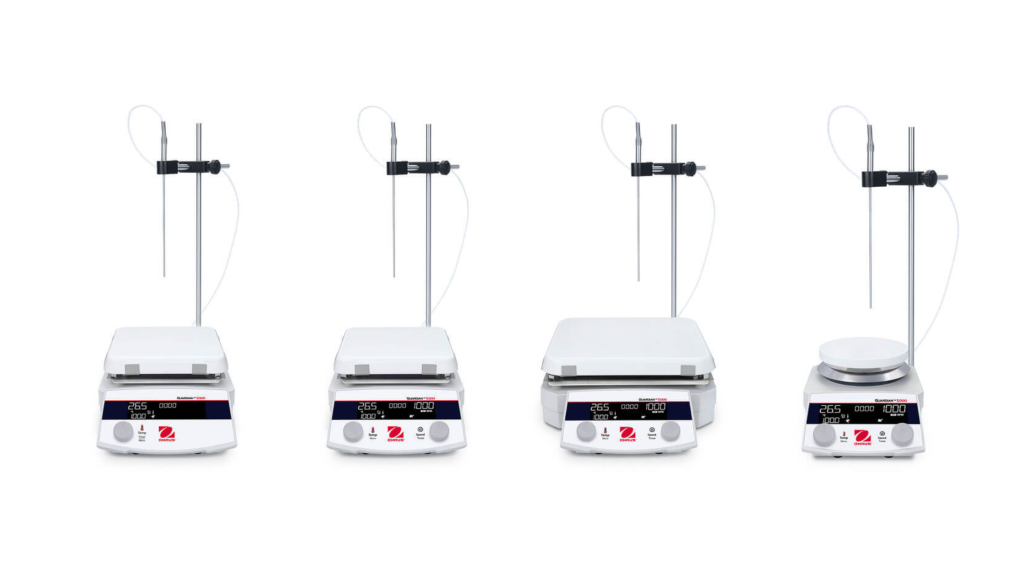
Exploring the OHAUS Guardian 5000 hotplate stirrer kits
Yorlab’s selected Guardian 5000 bundles include a 20 cm stainless steel temperature probe and a probe holder alongside the instrument.
Three configurations combine heating and magnetic stirring:
| Kit code | Model | Function | Plate Size |
| 30532080 | e-G52HP07C | Heating only | 7 × 7 in |
| 30532109 | e-G52HS07C | Heating and stirring | 7 × 7 in |
| 30910735 | e-G52HS10C | Heating and stirring | 10 × 10 in |
| 30981784 | e-G52HSRDA | Heating and stirring | 5.3 in diameter |
If your application needs heating without magnetic stirring, the 7 × 7 in e-G52HP07C bundle is also available: view the heating-only configuration.
From 1 October to 18 December 2026, the selected kits are available for the price of the corresponding unit alone, plus an extra 32% off. Read our current offer overview for the included accessories, bundle comparison and full conditions.
Get support with your laboratory setup
If you know the configuration you need, you can view the available bundles in our online shop to review specifications and order.
For help assessing suitability, speak to our sales team. Let us know your working volume, vessel size, target temperature and sample type, and we can help you compare the options and check the accessories required.